Overview
Civil Rights (+) hearings involve allegations of discrimination, Title IX matters, retaliation, student misconduct, and other related conduct. Generally, a complainant, or someone in the UNM community, files a complaint against a respondent, alleging a violation of university policy. The Office of Compliance, Ethics, & Equal Opportunity (CEEO) investigates the complaint and refers the complaint to OAH, or a complaint is referred by the Dean of Students. Our aim is to coordinate and conduct an administrative hearing to determine if the respondent is, or isn’t, responsible for the alleged violation.
The Complainant and Respondent are required to have an Advisor for the hearing and may also have a Support Person/Advocate for this process. If parties are unable to find an Advisor, OAH will assign a UNM Advisor.
There are two proceedings in the Civil Rights(+) hearing process:
1) Virtual pre-hearing conference
2) Virtual hearing
OAH coordinates and schedules both proceedings for all participants.
Virtual Pre-Hearing Conference
[Approx. 45 minutes]
The pre-hearing conference is an opportunity for a Hearing Officer to explain the hearing process and procedures, discuss witness and evidence requests, and answer any questions before the hearing. Advisor attendance at the pre-hearing conference is not required, but highly recommended. After the pre-hearing conference, participants will receive a Pre-Hearing Conference Summary that outlines the Hearing Officer’s decisions regarding witnesses and evidence permitted at the hearing.
Virtual Hearing
[Approx. 2-6+ hours]
The hearing is a neutral, non-confrontational forum for a Hearing Officer to get a complete and accurate understanding of the information in the investigatory report from parties and witnesses, to then issue a written decision. Each party may provide an opening statement, testify, question their witnesses, question the other party’s witnesses via an Advisor, testify on their own behalf, and provide a closing statement.
Order of Hearing
Please note: The following is a model example intended to illustrate the general sequence of testimony in a UNM Administrative Hearing. Actual hearing procedures may vary based on scheduling considerations, the nature of the subject matter, and the availability of participants. The order and length of each phase are determined on a case-by-case basis.
Complainant’s Witnesses

Respondent’s Witnesses

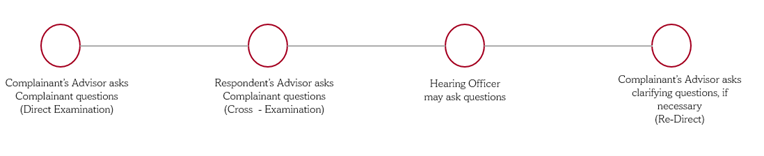

*The Hearing Officer has discretion to change the order of the hearing as needed.
After the Hearing
Participants may submit a Written Argument and Impact Statement to OAH by a deadline provided by the Hearing Officer. The Hearing Officer will then consider all evidence and testimony and issue a written decision. If there is a finding of responsibility, disciplinary action will be determined by the appropriate office (not OAH) and included in the written determination.
We understand that waiting for a decision can be difficult. Because every hearing involves different facts, evidence, and circumstances, we are unable to provide a set timeline for issuing a written determination. Participants may appeal the determination to the President’s Office. OAH is not involved in facilitating the appeal process.